

Why Remote Work Is Failing (and How Smart Companies Are Fixing It)
Strategies to Build Strong, Connected Teams—No Matter Where They Work

I was listening to one individuals experience of working remote during Covid, and they explained how isolated they felt from the team - no opportunity to build connections. It ended up with them leaving the business and moving elsewhere. Most assume tech businesses tend to be better equipped to transition to remote work, that's not necessarily the case.
Remote work just doesn't just mean work from home, it could be teams that are in different offices distributed across the country/continent/time zones.
It's this isolation that takes a toll on individuals. Covid was a significant disruption in the way many businesses worked. For tech teams the shift was remote work, I was used to it so it wasn't a big shift but for others this was a new way of working.
These days we see many businesses forcing employees in to the office for the purposes of building culture. It seems they've had varying results, from some individuals, they happy to having an opportunity to socialize to others feeling resentment (I would care to guess most have some degree of resentment especially if they're required in fulltime).
Scott Galloway mentioned on a podcast that most employees only stay around when they have 1 friend at work. Should that friend move on, chances are that employee will also. I've quit jobs in the past resulting in my entire team quitting within weeks. Obviously, that isn't ideal for an organization, so let's explore how to build connection with remote teams.
It's entirely possible to build culture while being remote. There are organizations that have done it successfully - that is build remote organizations and teams with a culture that nourishes employees - and there are lessons we can learn from them.
The Core Problem With Distributed Teams
We have remnants from the Industrial Revolution in all areas of business, it is a key factor in the problem of how leaders view organizations. Most still see it as a machine rather than a social system and we see that both in language and KPIs we measure against.
Take for example the way management executes changes:
Plan structural changes
Rollout to your team
Monitor
The approach is very similar to how you would manage machines hoping that everything continues to work once enacted.
I believe this is the core issue in a lot of work cultures - you can't manage what you don't monitor. And what is being monitored for remote teams cannot be the same as what was when everyone was in the office - one could argue that in office management is also incomplete but that is besides the point.
As more and more disruptions are taking place in the marketplace (covid, housing crisis, cost of living, etc.) that challenge the old ways of working, it can be deeply unsettling to the point that most people would rather return to their definition of 'normal'. We can expect these kinds of disruptions to continue, AI will automate significant portions of traditional work and we will need to reevaluate the definition of an organization and how its managed.
As humans, we are motivated by purpose, and companies with strong culture have this defined well and it is the most compelling reason for employee retention (with the job itself being a close second). This purpose extends far beyond a physical location, multi-national companies have long existed and have produced.
Distributed vs Remote teams
I've been working remote since 2013 and worked/managed distributed teams long before then. There is a difference between an entire team being distributed and being remote (often outsourced). Remote means that most of the team might be in located near each other, it might be a few offices but generally they tend to be in the same time zone.
A few interesting patterns I have observed:
With a remote team, you can just visit and setup events. That alone doesn't build culture, but it does help start the process.
Teams outside of Canada and US take lunch very seriously, and a lot of bonding happens over this period. I've found it can be a be a longer lunch break and then they will work later. I have done remote lunches (people eating together while on a video conference) and its enabled me to learn more about individuals on my teams and support their concerns - these can be a nonthreatening way for people to express themselves and a great way to connect.
Food plays a strong role in teams connecting. Food (from conversation to trying new foods) is a great way to learn about each other's backgrounds, as part of that people learn how to work with each other.
Energy needs to be put in to define and nurture that culture (this can be taken for granted by going to lunch with team mates and bonding over the local food joints/sports teams/relevant news). It might seem then being in the office is the better choice to build culture, I would argue culture still needs to be driven and not taken for granted.
3 Companies That Do It Well - Lessons We Can Take
Zapier:
Zapier has been remote since its inception, I can see the benefit especially for early stage startups. Not having to pay for office leases and having the talent pool for hiring being location agnostic are great reasons. To build culture and help people be engaged they focus on communication and collaboration. It starts with their hiring process: they look for self starters; people who when they see an opportunity to improve will chase it down and support others.
They've focused on transparency, communication patterns and documenting key decisions so that they can be referenced later. The focus is to how to enable a distributed team across the globe working in different time zones. They realize the value of good management so invest the time to mature potential leaders insisting they have regular 1:1s, provide mentorship and coaching, focus on team operations, and organizational strategy.
My perspective: a distributed team brings lots of diverse ideas because of their life experiences, and it will help improve the work product. Being in an office environment does not translate to open communication. Managers overestimate their ability to read body language and misinterpret signals, and having clear communication is a requirement regardless of it is in person or virtual. Yes, the techniques and cues may be different, but they need to be explicitly applied regardless of the situation.
37Signals:
These are the people behind BaseCamp and have always had a refreshing perspective on how to approach work. Rework is a book worth reading written by their founders, sharing huge insights on challenging traditional business practices. As with other distributed companies, they embrace a strong vision and that naturally builds the culture around it. Their culture focuses on trust, autonomy, and responsibility. It means transparency becomes key on how they work. Some of the rules they incorporate are:
People have office hours and that's when you can book time with them to speak, as they realize interruption is costly to their flow
Minimal meetings with the smallest group necessary; ideas need to be flushed out before booking meetings with clear agenda
When people are dedicated to a sprint (which is 6 weeks for them), they will not disrupt them from their tasks and responsibilities
Lower management overhead, the focus is to hire people that are self starters (notice a pattern here). You won't see the business bogged down with lots of policies and bureaucracy
Business embraces constraints (resourcing, time, budget) and spends considerable effort to flush out what will be built; meaning a lot of features might be left out if they are low value
Don't believe in "burning the midnight oil" to look busy; understand people need to rest to produce quality outputs
My perspective: The fact they embrace constraints, rather than pushing back, is wonderful as it leads to asking the question with a different perspective. For instance, within Basecamp they provided a simple calendar and not a full on Outlook style calendar with significant feature set. The reason due to their constraints, they went and looked at their user data and determined a simple calendar is what all their customers wanted. From a security perspective, more code will always increase risk. The advanced calendar feature is one that their competitors offered, but the team determined that based on their data and constraints it wasn't worth the building cost if less than 1% of their customers were going to use it. That is a risk that may have seen customers leave, but one that they chose to take.
Gitlab:
It is one of the largest remote teams, and have been leaders in this space for a long time. In fact, they even have a published handbook that other's can used to adopt their way of working. Going remote is a process for a business and they did a wonderful job of highlighting what those transitional steps are: Skeumorph (focus is business continuity), Functional (processes begin to evolve), Asynchronous (processes support teams in different time zones, remove dependencies), and finally Intentionality (where maturity is reached and processes, policies focus on helping the team thrive).
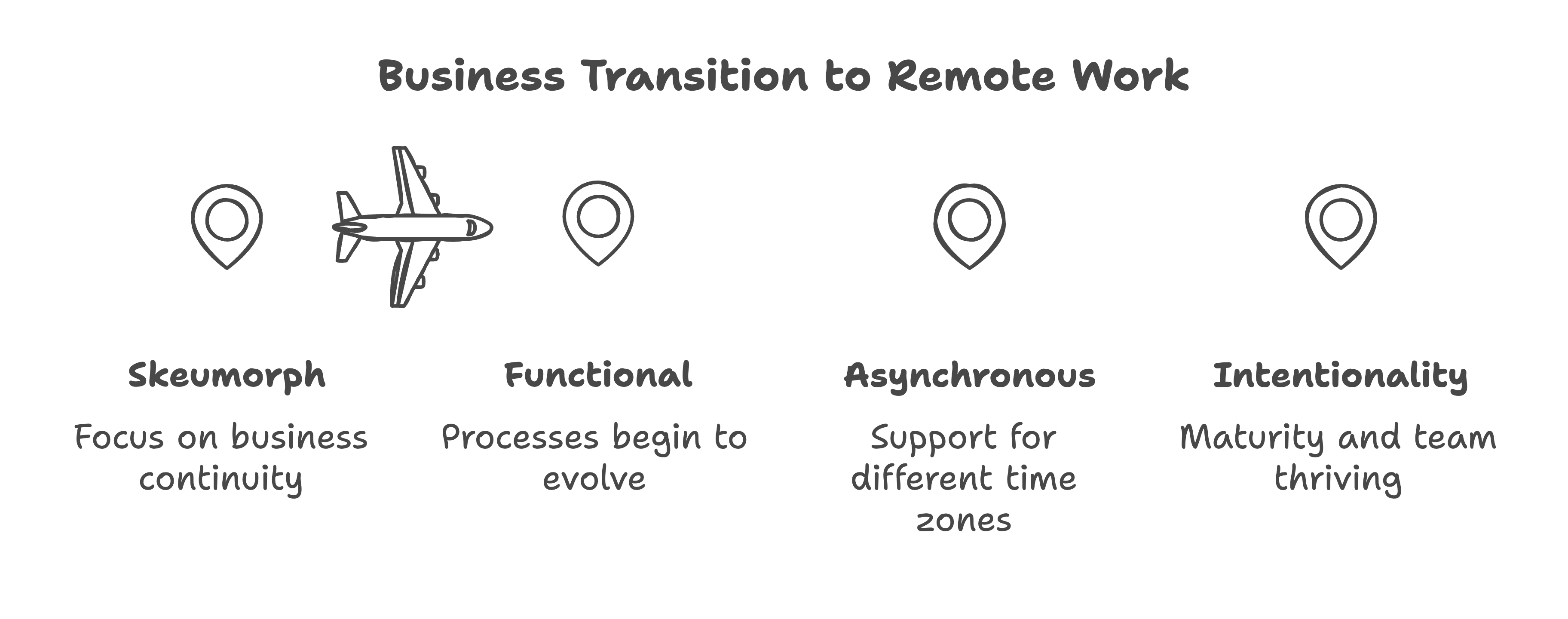
Let's look at some of their processes:
Remove the need for meetings - instead, people work independently on an idea and when they submit a merge request everybody puts their feedback into version control; their perspective is a replacement for meetings but all feedback is documented so no information is lost.
Document culture, values, vision in source control (and treat it like software) and not a traditional wiki; wikis get outdated and are only used by few people, source control gives historical insights as to why a decision was made, and the context.
The handbook is the source of truth and everyone is encouraged to contribute towards it; new onboarding employees get a checklist and connect with paired up buddies to see how they're doing
Transparent communication is key, and the company values different perspectives
Each team gets their own section in the handbook to help define their own subculture
Intentional social interactions conducted remotely. By creating space for those social settings, and focusing on them being remote experiences allows to build connections (for example: talent shows cooking fajitas at home)
Healthy delineation between work and personal life; focus on identity beyond work
My perspective: When I first came across their process I was concerned the organization might be too much like a machine (referring to the Industrial Revolution remnants), but I will admit it works. The effort to document key aspects provides value in so many ways allowing teams to be asynchronous and move away from dependencies - we've all seen the value of onboarding and how it depends on the person and environment. They remove these barriers, and have historical information on why decisions are made.
I love the fact they reduce meetings as they can not only be a time drain (for all involved), but often don't resolve anything. I've adopted similar patterns using Amazon six page memo where a skeleton of the proposal needs to be completed, and the fewest people necessary can provide feedback.
Lessons Learnt
Given the 3 businesses above, there's a lot of common ground and I wanted to highlight how you might be able to implement something similar for your teams. Even if you're in the office, it's rare for the entire team to be within the same space, so these practices will be beneficial in establishing a culture the team is bought into.
Determine your maturity and where you want to go; if you're team isn't ready to minimize meetings then strengthen processes and work towards it
Build your culture around trust, autonomy, transparency, and responsibility
Hire the right people that fit your organizational culture; you want them to be self-starters and want to encourage that behaviour
Document your culture, vision, values and decisions so that they can be referenced later; do this while minimizing bureaucracy
Invest in training management to enable the team
What is the one thing you believe makes a good distributed team?